dipthongs ae au ei eu oe ui
consonants
The digraphs ⟨ph⟩, ⟨th⟩ and ⟨ch⟩ are from greek and stand for the aspirated consonants /pʰ/, /tʰ/ and /kʰ/
vowels
       front  centr  back
close  i i:          u u:
mid    e e:          o o:
open          a a:
where the aeiou correspond to graphemes and also kind of the ipa phonetic symbols.
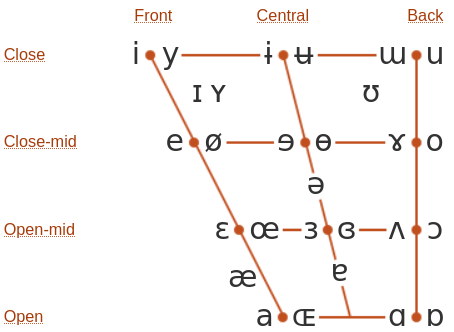
roundedness
unrounded: i, e, a
rounded: y, u, o
typing
the IPA chart has no symbol for exactly-mid vowels, so I just like to use e and o. it has no symbol for a central open vowel as well, so I just use the front-open symbol which is ascii a.
o
A mix of /o/ and /ɔ/. English distinguishes between /o/ (as in "ode") and /ɔ/ (as in "awesome"). For Latin I try to go halfway between the two, but more towards /ɔ/ because it probably would've drifted to distinguish itself from /u/.
e
a mix of /e/ and /ɛ/. English doesn't have /e/.
a
a mix of /a/ and /ɑ/. English doesn't have /ɑ/.
y
rounded version of /i/
mike salter and john coombs said that the last e in -ere is pronounced as /
ə/ not /ɛ/????
how to say urbs
created: 2026-02-22 Sun 16:50
it is not the back open-mid vowel (e.g. glorious, english Marcus). latin u is a back close vowel, like "oops" or "zoo". (it's rounded as well.)
urbs: say "furens", then "furbs" then "urbs". remember that s is unvoiced.
it isn't "werbs", (lips don't close at the start)