[30] - prosecution is invalid
1
… sunt autem duo crimina, auri et veneni; in quibus una atque eadem persona versatur.
- auri, veneni - genitives of charge
- verbs of accusation take the genitive of the thing they are being accused of
- not in the syllabus, so the HSC won't ask you what genitives they are
- persona = character, like a character in a play
- fitting in this context because Cicero will draw from characters in comedies
- eadem:
- by the same way, means
- at the same time, likewise
- versatur: PL 3rd passive
However there are two accusations, of gold and poison, in which one and the same character is involved.
2
aurum sumptum a Clodia, venenum quaesitum quod Clodiae daretur, ut dicitur.
- daretur
- quod ... daretur - relative clause of purpose (main reason)
- the poison was acquired for the purpose of giving to clodia
- the poison which was to be given to Clodia
- subjunctive of allegation (lesser reason)
- in section 32 he repeats stuff prosecution said without using subjunctive allegation
- quod ... daretur - relative clause of purpose (main reason)
- sumptum a Clodia - esse ommitted from indirect statement, kind of common of Cicero
The gold was taken from Clodia, the searched-for poison which was to be given to Clodia, as it is said [by the prosecution].
3
omnia sunt alia non crimina, sed maledicta, iurgi petulantis magis quam publicae quaestionis.
- iurgi, quaestionis - genitives of quality/description describing maledicta
- they have an adjective each - characteristic of genitives of quality/description
- characteristic because you are making a statement on what sort of quality the genitive is
- and also because stuff compared with quam are in the same case
- they have an adjective each - characteristic of genitives of quality/description
- iurgium, iurgi, iurgii quarrel, brawl
- magis mage adv more
All the others are not accusations, but insults, more of impudent quarrels than an investigation of the state.
4
‘adulter, impudicus, sequester’ convicium est, non accusatio; nullum est enim fundamentum horum criminum, nulla sedes; voces sunt contumeliosae temere ab irato accusatore nullo auctore emissae.
- cintumelia -ae f (verbal) insult (physical) assault
- nullo auctore ablative absolute with present participle of "to be" ommitted
- "sequester" - refers to how in the Pompeii thing, Caelius wasn't the main actor but like a helper
"Adulterer, shameless, middleman" is an insult, not an accusation; in fact, nothing is the foundation of these crimes, there are no seats,
commentary
Opening Tone
- matter of fact
- redirecting the focus to Clodia/bringing her into the matter
- trivialising what Clodia experiences
- lexical chain of words reducing Clodia's persecution to insults
sunt autem duo crimina, auri et veneni; in quibus una atque eadem persona versatur. aurum sumptum a Clodia, venenum quaesitum quod Clodiae daretur, ut dicitur. omnia sunt alia non crimina, sed maledicta, iurgi petulantis magis quam publicae quaestionis. ‘adulter, impudicus, sequester’ convicium est, non accusatio; nullum est enim fundamentum horum criminum, nulla sedes; voces sunt contumeliosae temere ab irato accusatore nullo auctore emissae.
why is it useful for Cicero to attack Clodia?
- it was considered nefas for prostitutes to testify
[31] - what the prosecution said
The prosecution speech for this trial hasn't survived, which means everything we know about the prosecution was inferred from Cicero's speech
1
horum duorum criminum video auctorem, video fontem, video certum nomen et caput.
- author comes from auctor
- nomen et caput referring to Clodia
I see the author of these two accusations, I see the origin, I see the obvious name and head.
2
auro opus fuit; sumpsit a Clodia, sumpsit sine teste, habuit, quamdiu voluit.
- opus est + ablative = the <thing in ablative> is needed
- you can say "ablative with opus fuit" or "ablative of separation" - since if you need something, you are separated from it.
- careo (I lack) also takes the ablative
- sumo, sumpsi, I take, buy, borrow
Gold was needed, it was taken from Clodia, taken without a witness, he had it, for as long as he wished.
This is Cicero stating what the prosecution has said.
3
maximum video signum cuiusdam egregiae familiaritatis.
- cuiusdam egregiae familiaritatis - genitive of quality
I see the great marks of a certain remarkable closeness.
Simplification: the stuff in the prev sentence (auro ... voluit), which is what the prosecution has said, is evidence that suggests Clodia and Caelius were in a close relationship.
4
necare eandem voluit; quaesivit venenum, sollicitavit servos, potionem paravit, locum constituit, clam attulit.
- in this phrase, why does Cicero not use the subjunctive, if he's trying to defend Caelius
- attulit - referring to bringing the poison
He wished to kill the same person; he sought poison, he incited servants, he prepared a drink, decided the location, he carried [it] secretly.
This is referring to the handover of poison that was planned to happen at the bathhouse. (It didn't actually happen).
5
magnum rursus odium video cum crudelissimo discidio exstitisse.
- video ... exstitisse - indirect statement
- exstitisse - from existo, existere, extiti, no passive.
I see, again, that great hate had appeared with the cruelest separation.
6
res est omnis in hac causa nobis, iudices, cum Clodia, muliere non solum nobili verum etiam nota; de qua ego nihil dicam nisi depellendi criminis causa.
- nobis - dative, indirect object referring to the defense
- causa - technical term, "cause" as in a cause that you fight for.
- iudices - vocative
- muliere - ablative, in apposition with Clodia
- solum - adv only, merely
- verum - adv truly, yes, in truth - NT truth
- etiam - adv also, besides, even, actually
- criminum criminis NT accusation, charge, reproach
- dicam - future indicative/present subjunctive
- genitive + causa = for the sake of
- is a quasi preposition apparently???
- e.g. amoris causa for the sake of love
- often comes with a gerundive
- depellendi criminis causa
- commentary says the depellendi criminis is possessive, hehe
- nobili, nota pun
- both come from novi
- nobilis - famous, in a good sense
- nota - known, and for a
All the matter in this case for us, jurors, is with Clodia, a woman not only noble but also in truth notorious; about her I shall speak nothing except for the sake of destroying the charge (literally: for the sake of the charge to be destroyed).
Cicero is saying the "de qua ego nihil dicam" because it's considered rude (in aristocratic circles) for a man to insult a noblewoman, especially since Clodia is a widow.
nomen, nominis NT
caput, capitis NT
Simplification: no matter which
[32] - why I insult Clodia
sed intellegis pro tua praestanti prudentia, Cn. Domiti, cum hac sola rem esse nobis.
- Cn. Domiti: words ending in -ius have vocative -i, (it entirely removes the us)
- Gnaeus Domitius was the judge of the case
- praestanti: ablative, i stem
- [rem nobis] esse [cum hac sola]
But you understand, for your outstanding knowledge, Gnaeus Domiti, that the matter (for us) is with this person alone.
quae si se aurum Caelio commodasse non dicit, si venenum ab hoc sibi paratum esse non arguit, petulanter facimus, si matrem familias secus, (ignore the comma) quam matronarum sanctitas postulat, nominamus.
- quae: subject, refers to Clodia
- ab hoc = by this man (by Caelius). Caelius would be sitting next to Cicero in the court.
- petulanter = impudently (rude)
- matrem familias: literally mother of the family (familias is an old genitive). but it's just a Latin technical term, materfamilias, like paterfamilias.
If she did not say that she herself lent the gold to Caelio, if she did not clarify that the poison from this had been prepared for herself, we are acting impudently if we accuse the mistress of the household, whom the integrity of matrons prosecutes.
sin ista muliere remota nec crimen ullum nec opes ad oppugnandum Caelium illis relinquuntur, quid est aliud quod nos patroni facere debeamus, nisi ut eos qui insectantur repellamus?
- ista muliere remota ablative absolute
- illis: (in syllabus): dative of interest, (out of syllabus) dative of reference, because there's only one dative. dative denotes a third party who is involved somehow in the thing
- indirect question somewhere here..???????
- insectantur - sense of attacking furiously. but for HSC just translating as attacking is fine.
But if that woman was removed, there is not any accusation or resources left to them (the prosecution) to attack Caelius, what else is there, that we patrons ought to do, except for the purpose of driving out those who are attacking?
quod quidem facerem vehementius, nisi intercederent mihi inimicitiae cum istius mulieris viro—fratrem volui dicere; semper hic erro.
- At this point, Cicero and Clodius hated each other very much.
- Incest: probably didn't happen, but who knows. Women were supposed to have the most socially acceptable sex life ever, so [making rumours about how sexually deviant Clodia is] is a good way to give the juror bad vibes
In fact, I would do it more vehemently, if the hostilities did not hinder [it], the hostilities between me and the husband of that woman—I wanted to say brother; I always make a mistake here.
nunc agam modice nec longius progrediar quam me mea fides et causa ipsa coget: neque enim muliebris umquam inimicitias mihi gerendas putavi, praesertim cum ea quam omnes semper amicam omnium potius quam cuiusquam inimicam putaverunt.
- mea fides - basically "the duty to my client"
- gerendas - gerundive
- mihi - dative of agent
Now, I will do [it] moderately, and not proceed further than what my faith and the case itself will compel me [to do]: for I have never considered, at any time, that feminine enemities will be carried against me, especially when everyone believed that she would always [be] a friend of all, rather than an enemy of anyone.
[33] - Cicero summons Caecus
1 - sed tamen ex ipsa
sed tamen ex ipsa quaeram prius utrum me secum severe et graviter et prisce agere malit, an remisse et leniter et urbane.
- quaeram futr
- utrum ... malit indirect question introduced by utrum & quaeram
- me ... agere nested indirect statement introduced by malit
- ipsa in ex ipsa refers to Clodia
- prius adv previously, before - maybe take it as prius ago..?
- secum = se + cum (se refers to Clodia)
- prisce - old fashionedly, as it was in the past
- urbane - in the new way, coming from "in the city", where people do things in a new way
But however, before [this], I will ask from Clodia, whether she would prefer that I deal with her severely and gravely and strictly, or gently and slowly and politely.
2 - si illo austero more ac modo
2.1
si illo austero more ac modo, aliquis mihi ab inferis excitandus est ex barbatis illis, non hac barbula qua ista delectatur, ...
- si - conditional clause with implied verb. The "full" clause would be "si malit agere illo austero more ac modo".
- how do you distinguish between conditional clauses with implied verbs and stuff like "if true, then..."
- austerus: gloomy; serious
- mos, moris: nature, manner;
- illo austero more ac modo abl.manner
- mihi dative of agent, with gerundive excitandus
- ista referring to Clodia
- he would've pointed to her at this point
- qua referring to barbula
- relative pronouns have to match gender and number, but not necessarily case
- ablative, nominative is quae
- abl.agent
- [non hac barbula] [qua ista delectatur]
- hac barbula
- ablative of description
- the adjective is hac
- non aliquis cum hac barbula
- Romans were also people, so like Cicero would've been clean shaven because it's the style for men his age. Younger people would be more trendy
- ablative of description
- qui referring to aliquis, or the inferred aliquis that illa horrida describes
If with that serious manner and method, someone from the underworld must be summoned by me, from those bearded people, not [someone] with this little beard, which Clodia is delighted by, ...
small commentary
hac barbula ... illa horrida one would imagine that Cicero would point to various beards in the court, to embarrass Clodia like "oooh that guy with that beard's your type haha"
2.2
... sed illa horrida quam in statuis antiquis atque imaginibus videmus, qui obiurget mulierem et pro me loquatur ne mihi ista forte suscenseat.
- horrida - bristling.
- imago - a bust or a death mask, contrasted with statua, which is a full-body statue.
- qui obiurget ... loquatur relative clause(s) of purpose. "qui ... obiurget ... et [qui] loquatur"
- loquatur subjunctive
- mihi dative with compound verb - suscenseat
- suscenseat
- innate passive meaning
- compound because: sub + cendo → succendo → succensus (PPP) → succensus + eo → succenseo (new verb) → suscenseo
- ne ... suscenseat nested purpose clause
Death masks - wax masks (like plaster casts of people's faces when they died). They would've been hung in the atrium like in a row. And they were probably like painted and coloured. It could also be a bust instead of a mask that was in the atrium.
... but [someone] with that rough one, which we see in ancient statues and pictures, so that he scolds the woman and speaks for me, so that she would not, by chance, get angry at me.
3 - exsistat igitur ex hac ipsa familiar
exsistat igitur ex hac ipsa familia aliquis ac potissimum Caecus ille; minimum enim dolorem capiet, qui istam non videbit.
- existat subjunctive, indirect command
- potissimum adverb - in this sense "most appropriately [out of everyone]"
- Caecus - Appius Clodius Caecus. He was blind and cognomen'd caecus because he was blind. caecus as a word means something hidden or something that can't see. Here Cicero is punning on Caecus' name, it means both "that Caecus" and "that blind person"
- censor 312 BC, consul 307 & 296
- approximately 250 years ago
- for us in 2026, approximately someone in the 1770s. So like George Washington
- why does Cicero choose Caecus to "raise from the dead"?
- censor 312 BC, consul 307 & 296
Therefore, someone from this exact family should appear, and chiefly, that Caecus, for the person will take the smallest sadness [out of everyone], will not be able to see her.
4 - mulier, quid tibi cum Caelio

qui profecto, si exstiterit, sic aget ac sic loquetur: "mulier, quid tibi cum Caelio, quid cum homine adulescentulo, quid cum alieno?
- mulier - dismissive, aka not "my dearest granddaughter!!! uwu"
- exstiterit perf active subjunctive OR ftpf active indicative
- but it's ftpf because the rest of the sentence is futr indicative
- aget futr active indicative
- loquetur futr active indicative
- but it's ftpf because the rest of the sentence is futr indicative
- quid tibi cum Caelio tibi is dative interest, the verb is implied. the literal translation is "what is there for you with caelius"
- quid tibi cum - an
- adulescentulo - doesn't have to be a teenager, could be in his twenties. Cicero's point is that Caelio is too young for Clodia.
- alieno - relating to someone else. You can take it as "someone not related to you" or "someone else' man"
Indeed, if he were here, he will do such and say such: "woman, what [exists] for you with Caelius, what with a young man, what a stranger?
5 - cur aut tam familiaris
cur aut tam familiaris fuisti ut aurum commodares, aut tam inimica ut venenum timeres?
- tam adverb
- ut ... commodares
- familiaris ... inimica nom adjectives describing Clodia
Why were you either so familiar [with Caelius] that you lent gold [to him], or so hostile [to Caelius] that you feared poison?
6 - non patrem tuum videras
non patrem tuum videras, non patruum, non avum, non proavum, non abavum, non atavum audieras consules fuisse; ...
- [patrem, patruum ... atavum] ... consules fuisse indirect statement introduced by videras and audieras
- videras pluperfect active indicative
As mentioned before, Clodia's home would've had the imagines of all these people in the atrium.
You had not seen that your father, had not heard that your father's brother, your grandfather, your great-grandfather, your great-great-grandfather, your great-great-great-grandfather, had been consuls; ...
Cicero, as an equestrian/new guy, couldn't say the "DID YOU KNOW THAT EVERYONE IN YOUR FAMILY WERE CONSULS???" to Clodia, because Clodia could just rightfully reply "lmao at least they were consuls"
Point of saying this: Clodia is letting her ancestral dignity down, she is bringing shame to the Clodii.
Since the jurors were rich people, they would've cared about the family dignity a lot. So Cicero doing this is a great way to give the jurors bad vibes about Clodia.
Prosopopoeia - not ad hominem. HSC only point - they had an In Catalinam section where if you didn't acknowledge it as a prosopopoeia you could only get 13/15
prosopos - Greek for character (basically persona but in greek).
"poseia" - to make
In analysis - why does cicero say the things he does?
[34] - you bring shame to the family
nah Cicero ate and left no crumbs
0 - Q Metelli matrimonium
... non denique modo te Q. Metelli matrimonium tenuisse sciebas, clarissimi ac fortissimi viri patriaeque amantissimi, qui simul ac pedem limine extulerat, omnes prope cives virtute, gloria, dignitate superabat?
- te ... matrimonium tenuisse
- clarissimi ... fortissimi ... amantissimi genitive bc agreeing with Metelli
- doesn't mean "the most" - because saying Metellus was the most famous man in the state would've been a lie
- non goes with sciebas and modo goes with tenuisse. Metellus died 3 years ago, not very recent. But this is like implying that
- patriae genitive - objective genitive. Could take it as dat.advantage but the idiom is genitive. syllabus - "genitive with adjective" - because
- virtute, gloria, dignitate abl respect
- virtus - originally what makes men good men - masculinity
- gloria -
... besides, you did not know that recently, you held the marriage of Quintus Metellus, a man very distinguished and strong and most loving of the fatherland, and who, as soon as he had carried his foot from the threshold, had surpassed almost all citizens in virtue, glory, and dignity?
context
Met
mini commentary
"did you not know that you were married" Cicero simultaneously insults Clodia's intelligence and fidelity
omnes prope: "all citizens nearby", or "almost all citizens"??
1-4 - cum ex amplissimo genere
cum ex amplissimo genere in familiam clarissimam nupsisses, cur tibi Caelius tam coniunctus fuit? cognatus, adfinis, viri tui familiaris? nihil eorum. quid igitur fuit nisi quaedam temeritas ac libido?
- nupsisses plpf
- ex amplissimo genere in familiam clarissimam - the Metelli were also one of the aristocratic illustrious families like the Clodii,
- tibi dative with compound verb
- adfinis - could also be a client
- eorum partitive genitive
- libido - the older Latin meaning was broader than just "sex drive",
- temeritas, libido nominative
Since you married from a very esteemed family into a very distinguished household, why had Caelius been so intimate with you? [Was he] a relation, a neighbour, a friend of your husband? None of these. Then, what was it, if not a certain disgrace and passion?
The Romans love this sort of thing with ancestors doing manly things. Like
5 - te Q. illa Claudia admonebat
nonne te, si nostrae imagines viriles non commovebant, ne progenies quidem mea, Q. illa Claudia, aemulam domesticae laudis in gloria muliebri esse admonebat, non virgo illa Vestalis Claudia, quae patrem complexa triumphantem ab inimico tribuno plebei de curru detrahi passa non est?
- nonne te, ne quidem Q. illa Claudia, non virgo illa Vestalis Claudia, admonebat?
- nostrae imagines viriles - "images of male ancestors" from commentary - how?? - literally "our manly exemplars/images"
- ne - can mean indeed
Surely not, if our manly exemplars did not affect you, not even Quinta Claudia, my descendant, reminded you to be a rival of domestic praise and in feminine glory, nor that famous Vestal virgin Claudia, who having embraced her triumphing father, did not permit [him] to be dragged from the chariot by the enemy tribune of the plebs?
6 - aquam adduxi ut ea tu inceste uterere
cur te fraterna vitia potius quam bona paterna et avita et usque a nobis cum in viris tum etiam in feminis repetita moverunt? ideone ego pacem Pyrrhi diremi ut tu amorum turpissimorum cotidie foedera ferires, ideo aquam adduxi ut ea tu inceste uterere, ideo viam munivi ut eam tu alienis viris comitata celebrares?"
- bona noun virtues
- Pyrrhi genitive, "peace offered by Pyrrhus"
- pacem Pyrrhi ... foedera lmaoooo Cicero is like juxtaposing the "pact" he didn't allow
- uterere = utereris
- comitata in this specific case, from comito, not comitor
- pacem Pyrrhi diremi ... aquam adduxi ... viam munivi
- Romans were about to sign a peace treaty with someone called Pyrrus or whatever and then Caecus came to the whatever and shouted at everyone to not sign it
- Caecus built the Via Appia and the Aqua Appia
- Appia from his praenomen Appius
Why do fraternal sins move you more than paternal and ancestral virtues, repeated from us so much in men and also in women? Was it for this that I separated the peace of Pyrrhi, so that you can strike bargains every day with most disgraceful lovers, was it for this that I lead the water here, so that it can be used by you wickedly, was it for this that that I fortifed the road, so that you can celebrated it, having been accompanied by foreign men?
I too would like to divert water illegally from aqueducts <3
[35]
sed quid ego, iudices, ita gravem personam induxi ut verear ne se idem Appius repente convertat et Caelium incipiat accusare illa sua gravitate censoria?
- ita ... ut so x, as y
- verear, convertat subjunctive
- illa sua gravitate censoria ablative manner/means
But why did I, jurors, wear a persona so grave that I fear, lest the same Appius would suddenly turn himself over, and begin to accuse Caelius with that rigid severity of his?
sed videro hoc posterius atque ita, iudices, ut vel severissimis disceptatoribus M. Caeli vitam me probaturum esse confidam.
- videro ftpf
- disceptatoribus - disceptator, disceptatoris masc - arbitrator (a person to whom the authority to settle or judge a dispute is delegated), umpire, judge
- probaturum futr act. probaturum esse is not a ftpf because 1) perfect passive forms are only nominative and 2) if it was a ftpf then what is me doing there
But I will have considered this later, and yes, jurors, I will be confident that I will demonstrate the life of Marcus Caelius to even the most severe arbitrators.
tu vero, mulier – iam enim ipse tecum nulla persona introducta loquor – si ea, quae facis, quae dicis, quae insimulas, quae moliris, quae arguis, probare cogitas, rationem tantae familiaritatis, tantae consuetudinis, tantae coniunctionis reddas atque exponas necesse est.
- ea, quae ... quae has to be NT PL because facis ... dicis ... insimulas are all second person (so Clodia is the subject)
- ea ... probare indirect statement introduced by cogitas
- rationem ... reddas atque exponas apparently "render an account of and explain" (from the commentary)
In fact, woman — for now I speak with you yourself with no character having been introduced — if the things, which you make, which you speak of, which you alledge, which you labour at, which you argue, you believe to be true, you should give and explain an account of such familiarity, such experience, such union, it is necessary.
accusatores quidem libidines, amores, adulteria, Baias, actas, convivia, comissationes, cantus, symphonias, navigia iactant, idemque significant nihil se te invita dicere.
- idem also masculine plural of idem, eadem, idem bruh
- te invita ablative absolute apparently
Indeed, the accusers throw desires, loves, adulteries, Baiae, holidays, banquets, feastings, songs, musicians, ships, and the same people demonstrate that they say nothing with you unwilling.
quae tu quoniam mente nescio qua effrenata atque praecipiti in forum deferri iudiciumque voluisti, aut diluas oportet ac falsa esse doceas aut nihil neque crimini tuo neque testimonio credendum esse fateare.
- quoniam tu (mente nescio qua effrenata atque praecipiti) [quae deferri in forum iudiciumque] voluisti, oportet aut [diluas] ac [doceas [falsa esse]] aut [fateare [nihil neque crimini tuo neque testimonio] credendum esse].
- quae NT pl object
- nescio can't be adj dsc mente since mente F
- nescio qua - a form of nescio quid (= nescioquid), an idiom meaning "something".
- fateare omg an abbreviated 2nd person passive!!! fatearis
- diluas oportet ... doceas .. fateare - oportet governs diluas, doceas, and fateare. oportet often doesn't use ut
Because, with some unrestrained and precipitous mind, you had wanted these to be carried into the forum and the trial, either it is required that you wash away or you teach that it is false or you admit that nothing or your accusation or the testimony is to be believed.
[36]
**sin autem urbanius me agere mavis, sic agam tecum; removebo illum senem durum ac paene agrestem; ex his igitur tuis sumam aliquem ac potissimum minimum fratrem, qui est in isto genere urbanissimus; qui te amat plurimum, qui propter nescio quam, credo, timiditatem et nocturnos quosdam inanes metus tecum semper pusio cum maiore sorore cubitavit.
- urbanius comparative adv from NT comparative adj
- nescio quam inflection of nescioquid
- nescio quam timiditatem et nocturnos quosdam inanes metus accusative with propter
But, if however [you prefer that] I act more urbanely, I will do such with you; I will remove that severe and nearly unsophisticated old man; thus, from these [young men] of yours,I should take up someone, and chiefly your littlest brother, who is very civilised in that sort; who loves you greatly, who, I believe, on account of some fear and certain nocturnal foolish anxieties, always as a little boy slept with his older sister, with you.
eum putato tecum loqui:
“quid tumultuaris, soror? quid insanis?
‘quid clamorem exorsa verbis parvam rem magnam facis?’
- putato not PPP of puto, putare. future imperative singular of puto, putare TODO: what in shells is
- tumultuaris from tumultuor
It will believe that he speaks with you: "Why are you upset, sister? Why do you act crazily? Why, having raised an outcry, do you make a small thing big?
vicinum adulescentulum aspexisti; candor huius te et proceritas, voltus oculique pepulerunt; saepius videre voluisti; fuisti non numquam in isdem hortis; vis nobilis mulier illum filium familias patre parco ac tenaci habere tuis copiis devinctum; non potes; calcitrat, respuit, repellit, non putat tua dona esse tanti. confer te alio. habes hortos ad Tiberim ac diligenter eo loco paratos quo omnis iuventus natandi causa venit; hinc licet condiciones cotidie legas; cur huic qui te spernit molesta es?"
- pepulerunt - take as "moved", not "driven away"
- familias patre - inflection of paterfamilias
- licet condiciones ... legas from commentary: "you may choose love affairs"
You saw a nearby young man; this beauty and height, face and eyes moved you; you wanted to see [him] more often; you were not never in the same garden; you, a noble woman, want to have that son, with the paterfamilias frugal and stubborn, bound by your resources; you are not able to; he kicks, rejects, pushes away, he does not think your gifts are of great size. Bring together, with you elsewhere. You have gardens at the Tiber and [things] having been prepared carefully at this location, which all youth visit, with cause for swimming; here, you may choose love affairs daily, why are you so annoying to this [person] who despises you?"
[37]
redeo nunc ad te, Caeli, vicissim ac mihi auctoritatem patriam severitatemque suscipio.
- Caeli special vocative form.
- note from earlier: Cn. Domiti: words ending in -ius have vocative -i, (it entirely removes the us)
I now return to you, Caelius, again and so I can receive for myself the father's title and severity.
sed dubito quem patrem potissimum sumam, Caecilianumne aliquem vehementem atque durum:
"nunc enim demum mi animus ardet, nunc meum cor cumulatur ira"
- quem patrem potissimum sumam relative clause of purpose
- to future me: I have translated sumam as "for me to take up", but there is NO DATIVE and NO INFINITIVE here.
- mi: meus or mihi?
But I doubt which father is most suitable for me to take up, whether someone Caecilian, vehement, and stern:
"For now at last the mind burns for me, now my heart is piled with anger,"
aut illum:
"o infelix, o sceleste!"
or him:
"Oh unlucky, oh wicked!"
ferrei sunt isti patres:
"egone quid dicam, quid velim? quae tu omnia
tuis foedis factis facis ut nequiquam velim,"
There are those fathers of iron:
"What should I say, what should I wish? You do all this, with your disgraceful actions, so that I wish in vain."
vix ferendi [sunt]. diceret talis pater: "cur te in istam vicinitatem meretriciam contulisti? cur inlecebris cognitis non refugisti?
They will be brought with difficulty. The father would say such: "Why had you brought yourself into that meretricious closeness? Why do you not flee from known treachery?
"cur alienam ullam mulierem nosti? dide ac dissice;
per me tibi licet. si egebis, tibi dolebit, non mihi.
mihi sat est qui aetatis quod relicuom est oblectem meae."
- dide ac dissice scatter and squander, from commentary.
- per me for my part, as far as I'm concerned
- qui ... oblectem relative clause of purpose
- relicuom = reliquum
- qui oblectem [quod relicuom est meae aetatis]
Why did you know any stranger woman? Scatter and squander; it is allowed for you for my part. If you will be without, it will hurt for you, not for me. There is enough for me so that I may entertain that which is left of my life."
[38]
huic tristi ac derecto seni responderet Caelius se nulla cupiditate inductum de via decessisse.
- huic tristi ac derecto seni dative indirect object
- derecto derectus a um; straight/not curved, direct/absolute
- decessisse from decedo.
- nulla cupiditate ablative
Caelius may respond to this sad and direct old man that he left the way, having been influenced by no eagerness.
quid signi? nulli sumptus, nulla iactura, nulla versura. at fuit fama.
- quid signi - signi is taken as proof? partitive genitive. take as quid signi est.
- versura ae f - a turning around; a borrrowing of money
What proof is there? Not any expenses, not any corst, not any borrowing. But there was a rumour.
quotus quisque istam effugere potest in tam maledica civitate?
- quotus quisque "there are few people who"
- ista referring to the rumour, one of the few instances when it doesn't refer to Clodia...
How few people are (potest is singular though) able to flee that [rumour] in such an evil community?
vicinum eius mulieris miraris male audisse cuius frater germanus sermones iniquorum effugere non potuit?
- vicinus, i - neighbour
- inquus inqua inquum - unjust, unfair; unkind, hostile
Are you astonished to hear wickedly about the neighbour of this woman, whose full brother wasn't able to escape the conversations of unjust people?
leni vero et clementi patri cuius modi ille est:
‘fores ecfregit, restituentur; discidit
vestem, resarcietur,’
In fact, to a lenient and merciful father, he [Caelius] is of this (cuius??) manner:
"He broke the doors, they will be repaired; He cut the clothes, it will be mended."
Caeli causa est expeditissima. quid enim esset in quo se non facile defenderet?
The case? cause? of Caelius / for Caelius is very easy. For what is there in which he can't easily defend himself?
nihil iam in istam mulierem dico; sed, si esset aliqua dissimilis istius quae se omnibus pervolgaret, quae haberet palam decretum semper aliquem, cuius in hortos, domum, Baias iure suo libidines omnium commearent, quae etiam aleret adulescentes et parsimoniam patrum suis sumptibus sustineret; si vidua libere, proterva petulanter, dives effuse, libidinosa meretricio more viveret, adulterum ego putarem si quis hanc paulo liberius salutasset?
- dives effuse ablative absolute
- meretricio, meretricia {adj} meretricious (pertaining to prostitutes)
- putarem 1PS impf sjt
- salutasset = salutavisset
I now say nothing against this woman; but, if there was any woman of that dissimilarity, who makes herself available to everyone, who without concealment, always had another that had been decided, everyone passionate could visit, by their own right, the grounds of her estate, her home, in Baias, and also she who had nurtured adulterers and supported the frugality of her fathers for her own consumptions, if [any woman is] freely a widow, [she is] petulantly shameless, with the riches having been poured out, this passionate woman lived in a meretricious manner, should I believe [that she is] an adulterer, if anyone had greeted this woman with a little too much freedom?
"Clodia's use of money to control her lovers ... Clodia flaunts her erotic adventures in public and behaves badly in private"
Woah this can be the material of the cutesy vocaloid song.

- Introduction: Clodia with Caelius
- Verse 1: various girlboss stuff and how she manipulates people.
- Chorus: sung by a group of male voices instead of a solo female voice. its an excerpt/summary of Cicero's attack against her.
- Verse 2: Caelius tries to poison her and kill her and then Clodia takes Caelius to court.
- Chorus
- Verse 2: Clodia, hearing the slander, gets mad and murders Cicero. She then murders Caelius.
- Outro: Clodia hooking up with another guy again, showing how she can do whatever and no one cares because she's too hot.
[39]
me when I procrastinate translating Latin to study motors vs me when I procrastinate mod 8 physics to translate Latin
dicet aliquis: "haec est igitur tua disciplina? sic tu instituis adulescentis? ob hanc causam tibi hunc puerum parens commendavit et tradidit, ut in amore atque in voluptatibus adulescentiam suam conlocaret, et ut hanc tu vitam atque haec studia defenderes?"
- ob takes acc
- adulescentiam adulescentia, adulescentiae F youth, youthfulness, young manhood
- studia studium, studi(i) - haec would be NT PL
Anyone would say: "So, your method is this? You prepare the young men like this? On account of this cause, the parent entrusted and gave this boy to you, so that he would establish his own youth in love and in enjoyments, and so that you would defend this life and these studies?"
ego, si quis, iudices, hoc robore animi atque hac indole virtutis atque continentiae fuit, ut respueret omnes voluptates omnemque vitae suae cursum in labore corporis atque in animi contentione conficeret, quem non quies, non remissio, non aequalium studia, non ludi, non convivium delectaret, nihil in vita expetendum putaret, nisi quod esset cum laude et cum dignitate coniunctum, hunc mea sententia divinis quibusdam bonis instructum atque ornatum puto.
- ego subject of verb puto at the very end
- quies, quietis F quiet, calm
- remissio, remissionis F a sending back, returninging; forgiveness
- sententia, sententiae F opinion, feeling, way of thinking
- divinus -a -um - divine, of a diety, sacred
- instructum, ornatum masculine (hunc is masculine) accusative
- hunc ... instructum atque ornatum indirect statement introduced by puto
I, Jurors, if anyone is with this strength of character and this this inborn quality of virtue and of self-control, then he would reject all enjoyments and construct all the course of his own life in labour of the body and in exertion of the mind; quietness would not please him, nor forgiveness, nor pursuits of equality, nor games, nor a feast; he would seek [nothing which is to be aspired to] in life, except that which would be a marriage with praise and dignity; I would believe in my opinion that this [was] furnished and prepared for certain divine advantages.
this is a very "if Cicero doesn't reach the verb in 15 minutes I'm legally allowed to overthrow the Republic" sentence
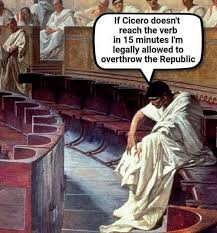
ex hoc genere illos fuisse arbitror Camillos, Fabricios, Curios omnesque eos, qui haec ex minimis tanta fecerunt.
- Camillos, Fabricios, Curios rhetorical plurals
- (see also commentary extract)
- haec referring to hoc imperium
- tanta describes haec
I imagine that from this group were had been those Camillus, Fabricius, Curius and all those, who made these things of such size from so little.
From Keitel & Crawford commentary:
M Furius Camillus was twice dictator and repelled an invasion of Gauls in 38 BC
C. Fabricius Luscinus, censor 275 BC, fought against the Greek Pyrrhus
M Curius Dentatus, consul 290, also fought against the Greek PyrrhusAll three were instrumental in securing Rome's freedom from foreign enemies and in consolidating and expanding Rome's power in Italy.
Such historical precedents (exempla) were a staple of Roman oratory.
Cicero brings up these famous, exemplary Romans to underline the impossible virtue of the ideal young man. He implies that there are not such Romans these days. Cicero will develop this point in the next few chapters.
Word Cache
repente
- suddenly
ideo
- for that reason, therefore, thus
cotidie
- every day
Vestalis
- of or pertaining to Vesta
virgo, virginis f
- an unmarried young woman
- a female virgin
domesticus, domestica, domesticum
- of the house, domestic, familiar, native
admoneo, admonere, admonui, admonitum
- to remind, recall, make remember
- w/ acc, dat - someone
- w/ gen, de + abl - of something
aemulus, aemula, aemulum adj
- striving to equal or excel, rivaling
- (in a bad sense) envious, jealous
progenies, progeniei f
- race, family, lineage, descent
quidem
- ADVERB
- indeed, in fact, at least
commoveo
- to move something in violent motion
- ...
- (figuratively) to excite, affect
viriles adj
- virilis, virile
-ne
- optionally added to the first word in a yes/no question
- if added to a negative word, affirmative is expected
- nonne intellegis? - do you not understand? (expecting "I do understand")
nonne
- "not", expecting an affirmative answer
- nonne intellegis? - do you not understand? (expecting "I do understand")
libido, libidinis f
- desire, passion
- wilfulness, caprice
- lust
temeritas, temeritatis f
- chance, rashness, disgace
adfinis, adfinis m/f
- neighbour
cognatus, cognati
- noun
- masc
- relation
- adj
- related
- connected, similar
coniunctus
- PPP of coniungo (with N)
coniunx
coniugo
- coniugo, coniugare, coniugavi, coniugatum
- to unite, especially in marriage
amplus
- ...
- esteemed, distinguished
amplissimus
- amplus
genere
- ablative of genus
- infinitive or some second-person future (??) of geno
simul
- at the same time, simultaneously
- (simul ... simul) both ... at the same time
extulerat
- effero
modo
- just, only
- recently, just now
- presently
- (modo ... modo) now ... now
denique
- finally, lastly
- besides
patruus paternal uncle
avus grandfather
proavus great-grandfather
abavus great-great-grandfather
atavus great-great-great-grandfather
familiaris
- adj familiaris, familiare
- familiar, of a household, intimate, friendly
- noun familiaris, familiaris masc
- servant, friend
aut
- or
- either ... or (aut .. aut)
profecto
- adv actually, indeed
minimum
- superlative of parvus
capiet
- 3P SG futr active indicative of capio
enim (always postpositive)
2. truly
3. yes
4. for, because
5. so