hic = this
hīc = here
commentary
two overarching questions:
- how does horace portray his persona?
- how does horace portray the yapper?
answers
- at the start
- horace
- meek
- terse
- polite
- yapper
- aggressive
- intrusive
- enthuiastic
- blabbering
- stichomythia
- short, truncated dialogue
- originated from greek tragedy where two people trade short lines for about like 30 lines
- horace doesn't care enough to say more
- vergil dialogue is turn based, like one person has a really long speech on X, Y, Z, and the replying person will be like "regarding X, regarding Y, regarding Z"
- like email
- also everything seems to pause while they talk
- meanwhile Horace dialogue is more "X", "re: X", "Y", "re: Y", "Z", "re: Z" (real time)
- horace
- donkey simile
| in story | irl |
|---|---|
| asellus | horace' persona |
| onus | conversation/yapper |
| asellus' reaction (drooping of ears) | persona is annoyed, defeated, resigned |
romans valued "honest" work so it was a bad thing that the yapper was doing stuff with "shifty" "trick" tactics - that didn't count as "hard work"
Horace is an individual critique
Juvenal is a cultural critique
Q. HORATII FLACCI SERMONVM LIBER PRIMVS
SERMO NONVS
Act One
1: yapper appears
ibam forte Via Sacra, sicut meus est mos,
nescio quid meditans nugarum, totus in illis:
accurrit quidam notus mihi nomine tantum
arreptaque manu 'quid agis, dulcissime rerum?'
'suaviter, ut nunc est,' inquam 'et cupio omnia quae vis.'
- ibam forte Via Sacra, sicut meus est mos,
- Via Sacra abl.place - Sacred Way
- nescio quid meditans nugarum, totus in illis:
- nescio quid (= nescioquid) is an idiom meaning "something"
- nugae, nugarum fpl nonsense, trifles
- gen.partitive
- meditans: has a sense of composing verses, so like Horace is walking along the street composing verses
- accurrit quidam notus mihi nomine tantum
- nomine abl.respect
- tantum adv only, merely
- arreptaque manu 'quid agis, dulcissime rerum?'
- arrepta manu ablative absolute
- quid agis is probably an idiom meaning "how are you?"
- 'suaviter, ut nunc est,' inquam 'et cupio omnia quae vis.'
- ==clarify the grammar of ut nunc est==
- quae acc pl dsc/omina
I was walking, by chance, on the Sacred Way, just like my nature is, composing something of nonsense, entirely in these: a certain person, known to me only by name, runs up and with my hand having been snatched:
"How are you doing, sweetest thing?"
"Pleasantly, as it is now," I say, "and I want all that you wish for."
commentary
opens very mundanely lmao
good questions for a trial: "compare the openings of horace and juvenal"
6: learned
cum adsectaretur, 'numquid vis?' occupo. at ille
'noris nos' inquit; 'docti sumus.' hic ego 'pluris
hoc' inquam 'mihi eris.' misere discedere quaerens
- cum adsectaretur, 'numquid vis?' occupo. at ille
- numquid vis lit. "what do you want" but i think it has a polite sense in roman culture??
- sector -ari -atus subjunctive in temporal clause? also imperfect for some reason??
- 'noris nos' inquit; 'docti sumus.' hic ego 'pluris
- noris perf active sjt
- Yapper referes to himself in the plural bc he is pompous
- hic long i by scansion
- therefore means "here" not "this"
- pluris gen.value?
- hoc' inquam 'mihi eris.' misere discedere quaerens
- hoc long bc first sylb, therefore abl not nom
When he pursued, "Is there anything you want?" I interrupt.
"You should know us," he says, "we are learned".
Here, I say, "you will be of more value to me, because of this."
8: anklebones
hoc' inquam 'mihi eris.' misere discedere quaerens
ire modo ocius, interdum consistere, in aurem
dicere nescio quid puero, cum sudor ad imos
manaret talos. 'o te, Bolane, cerebri
felicem' aiebam tacitus, cum quidlibet ille
garriret, vicos, urbem laudaret. ut illi
- hoc' inquam 'mihi eris.' misere discedere quaerens
- misere adv how can you tell?
- misere: could be a syncopated form of miserunt but like that doesn't work in this context
- ire modo ocius, interdum consistere, in aurem
- ire historical infinitive.
- ig u can have "I departed, seeking to walk faster" though
- or "seeking to leave miserably, and seeking to walk faster"
- but "miserably seeking to leave, I walked faster" makes the most sense
- also mirrors how consistere is also hist. infinitive
- ocius comparative adv
- ire historical infinitive.
- dicere nescio quid puero, cum sudor ad imos
- imos talos: literally: lowest ankles, but like do you have high ankles?? so here it's "all the way to the ankles"
- nescioquid: literally: I don't know what, translate as: something
- cum sudor ad imos - moment of epic poetry
- manaret talos. 'o te, Bolane, cerebri
- te accusative of exclamation
- Bolane vocative
- why is cerebri genitive??
- felicem' aiebam tacitus, cum quidlibet ille
- felicem dsc/te
- quidlibit: lit. whatever pleased it, translate as: something
- garriret, vicos, urbem laudaret. ut illi
- vicos: a street in the sense of a main street with commercial stuff around it, that you would mean when you say "I'm going to Chatswood", aka not the residential stuff.
Miserably seeking to leave, I sometimes walked more quickly, I stopped now and then, I said something in the ear to my slave, while sweat seemed to drip all the way to the anklebones.
"Oh you, Bolanus, lucky in your hotheadedness," I said, quiet, while he yapped about anything; praised the neighbourhoods, the city.
Miserably seeking to get away, I now walked more swiftly, now and then I stopped, saying something into the of my slave, while sweat dripped all the way down to my ankles. "Oh, you, Bolanus, lucky in your hotheadedness," I said quietly, when he chattered about anything, praised the neighbourhoods, the city.
//
discedere, consistere, dicere: historical infinitives, you know they are first person because it wouldn't make sense otherwise
13: yapper shows EQ
garriret, vicos, urbem laudaret. ut illi
nil respondebam, 'misere cupis' inquit 'abire:
iamdudum video; sed nil agis: usque tenebo;
persequar hinc quo nunc iter est tibi.'
try to keep adverbs near their verbs
cubat: has a sense of "lies sick"
circumagi: circum is "around", not necessarily all the way around, so here it means "to detour"
agam: either subjunctive/future
When I replied nothing to him, he said "You desperately wish to leave: I've seen it for a while; but it is no use: I will hold (follow) all the way; I will follow from here to where there is now a journey for you."
17: sick friend
persequar hinc quo nunc iter est tibi.' 'nil opus est te
circumagi: quendam volo visere non tibi notum;
trans Tiberim longe cubat is prope Caesaris hortos.'
'nil habeo quod agam et non sum piger: usque sequar te.'
demitto auriculas, ut iniquae mentis asellus,
cum gravius dorso subiit onus. incipit ille:
onus: 3rd declension neuter, acc
subiit: the SUBJECT is the one that goes under. the OBJECT is the one on top.
demitto; de = away, or de = drop, in this case drooping makes more sense
auriculas: diminuitive, little ears, can also have the sense of "poor little", so it's like pityable ears in
quod is referring to "ego canto" as a unit, not the object of canto.
"There is no need that you go around: I want to visit a certain someone who is not known to you; he lies (sick) far across the Tiber, near the gardens of Caesar." "I have nothing which I should do and I am not lazy; I will follow you all the way."
droop my ears, like a young ill-tempered donkey (lit: donkey of an unequal mind) when it goes under a too-heavy load with its back.
Act Two
21: citius possit
cum gravius dorso subiit onus. incipit ille:
'si bene me novi, non Viscum pluris amicum,
non Varium facies; nam quis me scribere pluris
aut citius possit versus? quis membra movere
mollius? invideat quod et Hermogenes, ego canto.'
He begins: if I knew myself well, you will not regard Viscus as a friend of more value, nor Varius; for who is able to write more verses or write more quickly than me? Who [can] move their limbs more softly? And Hermogenes envies this: I can sing.
26: relatives
interpellandi locus hic erat 'est tibi mater,
cognati, quis te salvo est opus?' 'haud mihi quisquam.
omnis conposui.' 'felices. nunc ego resto.
confice; namque instat fatum mihi triste, Sabella
quod puero cecinit divina mota anus urna:
Hic: long i = HERE, not THIS
quis: long i (quīs), is a contraction of quibus.
interpellandi: gerund. gerunds don't have the same sense of purpose/obligation as gerundives. but here translating as "spot of interruption" is less idiomatic than "spot to interrupt"
Here was a place to interrupt: 'do you have a mother, relatives, who need you to be safe?' 'I have no-one at all. I buried everyone.' 'Lucky ones. Now I give up. Finish me; for a sad destiny hangs over me, which Samnite old woman sang when I was a boy after the divine urn had been shaken:
abl abs
me puero, me puella is a common phrase for like "when I was a boy/girl"
Caesare Consule <- with Caesar being consul (abl abs with non-included est/fuit)
divina: adj, prophetic
abl + opus + form of sum = [abl noun] is needed
31: the prophecy
"hunc neque dira venena nec hosticus auferet ensis
nec laterum dolor aut tussis nec tarda podagra:
garrulus hunc quando consumet cumque: loquaces,
si sapiat, vitet, simul atque adoleverit aetas."'
"neither fearful poisons nor the hostile sword shall snatch him away, nor the suffering of the sides nor the cough nor sluggish gout: the babbling one will consume him one day: if he is wise, he should avoid yappers, as soon as his age has matured."'
mock epic
35: the lawsuit
ventum erat ad Vestae, quarta iam parte diei
praeterita, et casu tum respondere vadato
debebat, quod ni fecisset, perdere litem.
-
ventum erat ad Vestae, quarta iam parte diei
- ventum erat
- passive plpf
- from venio
- venio is imperfect in the passive
- "it has been come to" → "it has been arrived at" → "we have arrived"
- Vestae = [templum] Vestae
- quarta iam parte diei praeterita abl.absolute
- ventum erat
-
praeterita, et casu tum respondere vadato
- vadato - ablative absolute
- commentary says, "having posted a bond", which I believe means "having deposited money (or equivalent; this is the 'bond'), which will be returned to the depositor if they show up in court at the required time".
- vador, vadari, vadatus sum (deponent)
- to put (someone) under bail
- I think it means: to make someone deposit money in an attempt to ensure their appearance in court.
- Bail is a set of pre-trial restrictions that are imposed on a person charged with a criminal offence to ensure that they will not hamper the judicial process.
- thus the yapper seems to be the object of vatado, not its subject.
- to put (someone) under bail
- vadato - ablative absolute
-
debebat, quod ni fecisset, perdere litem.
- fecisset pluperfect
- debebat governs respondere and perdere
- commentary says quod refers (grammatically) to "casu tum respondere vadato debebat", but I have no idea what quod refers to semantically.
- A) if the yapper had not put himself under obligation to be present, he must forfeit his case
- B) if the yapper was not present, he must forfeit his case.
- C) if the yapper had not posted a bond, he must forfeit his case
- fecisset plpf seems to suggest A) or C)
We had come to the temple of Vesta, now the fourth part of the day had gone by, and then, by chance, having posted a bond, he must be present [at court], if he had not done this, he must forfeit his case.
* * *
for passive verbs, the subject is the one that's recieving the action (aka still the one in the nominative)
* * *
"it should be noted that Horace is in error when he says that if the Boor didn't show up, he would lose his suit. This may be cleverly intentional on Horace's part since he claims only two lines later that he doesn't know civil law." -- the commentary.
38: if you love me
'si me amas,' inquit 'paulum hic ades.' 'inteream, si
aut valeo stare aut novi civilia iura;
et propero quo scis.' 'dubius sum, quid faciam', inquit,
'tene relinquam an rem.' 'me, sodes.' 'non faciam' ille,
et praecedere coepit; ego, ut contendere durum
cum victore, sequor. 'Maecenas quomodo tecum?'
- 'si me amas,' inquit 'paulum hic ades.' 'inteream, si
- aut valeo stare aut novi civilia iura;
- et propero quo scis.' 'dubius sum, quid faciam', inquit,
- 'tene relinquam an rem.' 'me, sodes.' 'non faciam' ille,
- tene = te+ne
- et praecedere coepit; ego, ut contendere durum
- durum supply est
- cum victore, sequor. 'Maecenas quomodo tecum?'
"If you love me," he said "stay for a little while."
"I would perish, if I am either capable of standing up in court or if I know civil law; and I am hurrying to a place which you know."
"I am uncertain of what I will do", he says, "should I surrender you or the case?"
"Me, if you don"t mind."
"I will not do that", he says, and begins to lead the way; I follow, as it is hard to struggle with a conqueror.
Act Three
43: Maecenas
cum victore, sequor. 'Maecenas quomodo tecum?'
hinc repetit. 'paucorum hominum et mentis bene sanae.
nemo dexterius fortuna est usus. haberes
magnum adiutorem, posset qui ferre secundas,
hunc hominem velles si tradere: dispeream, ni
summosses omnis.' 'non isto vivimus illic,
- cum victore, sequor. 'Maecenas quomodo tecum?'
- Maecenas: the subject. also it's tecum. so it's "How is Maecenas with you", not "how you are with Maecenas".
- hinc repetit. 'paucorum hominum et mentis bene sanae.
- hinc: old ablative of hic
- nemo dexterius fortuna est usus. haberes
- dexterius: adverb; no one used money more skilfully
- fortuna: money, more generally good luck
- fortuna: ablative, usus takes an ablative
- magnum adiutorem, posset qui ferre secundas,
- posset is imperfect, because the infinitive of possum is posse
- qui: generic relative (type of person, and the verb is subjunctive..?)
- hunc hominem velles si tradere: dispeream, ni
- velles is imperfect, see posset above
- tradere: teach/introduce
- summosses omnis.' 'non isto vivimus illic,
- summosses → summovisses
* * *
"How is Maecenas with you?" He resumes from this point. "[He is] a man of a select few and a very sensible mind. No one used fortune more skilfully. You would have a big helper, who would bring favourable [things], if you were willing to teach (or: 'to introduce') this person: I would go to ruin, if you have not already cleared the path of all."
48: locus uni
summosses omnis.' 'non isto vivimus illic,
quo tu rere, modo; domus hac nec purior ulla est
nec magis his aliena malis; nil mi officit,' inquam,
'ditior hic aut est quia doctior; est locus uni
cuique suus.' 'magnum narras, vix credibile.' 'atqui
-
summosses omnis.' 'non isto vivimus illic,
-
quo tu rere, modo; domus hac nec purior ulla est
- rere: from reor, reri, so 2nd person present is reris, which gets contracted to rere
- present infinitive is reri
- a good author doesn't use it where the wording would be ambiguous
- modo
- long o, (modō), so it's the ablative/dative of modus, not modo the adverb, which has a short finishing o.
- i said abl of cause, but brophy said it's manner, because when you have a word meaning "method" in the ablative it's likely ablative of manner. like how
- quo: ablative of manner.
- NOT because it's agreeing with modo (relative pronouns don't do that). relative pronouns do the role in the new clause. here in the new clause, it's still an ablative of manner though. because like if someone said "who did you hit?" and I said "jessie", then "jessie" would still be accusative. same way, quo tu rere has abbreviated the rest of the statement, but even without vivimus, quo is still ablative.
- rere: from reor, reri, so 2nd person present is reris, which gets contracted to rere
-
nec magis his aliena malis; nil mi officit,' inquam,
-
'ditior hic aut est quia doctior; est locus uni
- uni dative
- Latin likes screwing with me
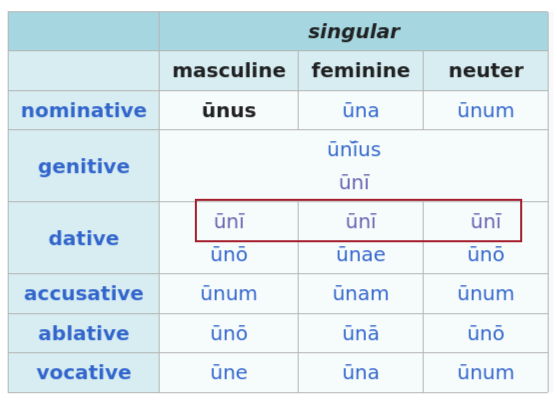
- Latin likes screwing with me
- uni dative
-
cuique suus.' 'magnum narras, vix credibile.' 'atqui
- cuique: NOT cui + que, a form of quisque
- uni cuique: one whoever = anyone
- understanding est locus uni cuique suus
- que is added to end of many pronouns to make them indefinite
- unus hominis, cui est locus
- unus hominis, cui est suus locus
- unus hominis, uni cui est suus locus
- (remove reference to one specific person, therefore it becomes indefinite) uni cuique est suus locus
"We don't live in that place in the manner which you think; any house is not more faultless than this one, or more foreign to these mischiefs; it makes no difference to me," I say, "because the richer or cleverer is here; there exists his own place for anyone."
* * *
que: 2 uses
- and
- tacked on the end of a lot of pronouns to make them indefinite
- indefinite = non-specific
- quis = who, quisque = whoever
52 - accendis cupiam
cuique suus.' 'magnum narras, vix credibile.' 'atqui
sic habet.' 'accendis quare cupiam magis illi
proximus esse.' 'velis tantummodo: quae tua virtus,
expugnabis: et est qui vinci possit eoque
difficilis aditus primos habet.' 'haud mihi deero:
- cuique suus.' 'magnum narras, vix credibile.' 'atqui
- credibile (NT acc) → magnum
- sic habet.' 'accendis quare cupiam magis illi
- habet used like "est" sometimes, with the implied object = subject
- e.g. quomodo habes = quomodo te habes, = "how do you have yourself"?
- accendo transitive, object is the quare cupiam indirect question
- quare adv - (interrogative) by what means, for what cause
- quare introduces indirect question cupiam.
- cupiam future|subjunctive
- habet used like "est" sometimes, with the implied object = subject
- proximus esse.' 'velis tantummodo: quae tua virtus,
- velis: present subjunctive
- expressing that the yapper only needs (→ a possibility, hasn't happened yet) to wish something in order for it to happen
- tantummodo adv - only, merely
- velis: present subjunctive
- expugnabis: et est qui vinci possit eoque
- eo: ablative of cause, referring to "[ille] est qui vinci possit" as a concept, "because of this"
- difficilis aditus primos habet.' 'haud mihi deero:
- difficilis aditus primos all acc PL; good display of different acc PL endings
* * *
"You tell a big thing, hardly credible."
"Yet like this it holds."
"You ignite the cause, for which I desire, even more, to be very close to him."
"You have only to wish it: such [is] your strength, you will conquer: and he is one able to be conquered and for that reason he has difficult first entrances."
* * *
velim tantummodo~
56: 🔥 the speech 🔥🔥
difficilis aditus primos habet.' 'haud mihi deero:
muneribus servos corrumpam; non, hodie si
exclusus fuero, desistam; tempora quaeram,
occurram in triviis, deducam. nil sine magno
vita labore dedit mortalibus.' haec dum agit, ecce
- difficilis aditus primos habet.' 'haud mihi deero:
- mihi: dative of disadvantage?
- muneribus servos corrumpam; non, hodie si
- exclusus fuero, desistam; tempora quaeram,
- fuero ftpf
- exclusus fuero is not ftpf excludor (that is exclusus ero); it is probably just exclusus as a participle adjective + fuero as "to be".
- but it's so weird?? why is it so close to the PPP+sum construction but isn't??? exclusus doesn't even have a regular adjective version???
- occurram in triviis, deducam. nil sine magno
- vita labore dedit mortalibus.' haec dum agit, ecce
"I will not fail myself: I will bribe the servants with gifts; if I will have been excluded today, I will not stop; I will seek opportunities, I will attack at the crossroads, I will escort [him]. Life gives nothing to mortals without great labour."
60
vita labore dedit mortalibus.' haec dum agit, ecce
Fuscus Aristius occurrit, mihi carus et illum
qui pulchre nosset. consistimus. 'unde venis et
quo tendis?' rogat et respondet. vellere coepi
et pressare manu lentissima bracchia, nutans,
distorquens oculos, ut me eriperet. male salsus
ridens dissimulare; meum iecur urere bilis.
- vita labore dedit mortalibus.' haec dum agit, ecce
- Fuscus Aristius occurrit, mihi carus et illum
- qui pulchre nosset. consistimus. 'unde venis et
- pulchre adv - excellently; well done!
- nosset = novisset
- also novi only has perfect tense forms, so pluperfect (as in this case) = imperfect
- subjunctive can also express reason that someone else gave that the author of the text doesn't really believe/doesn't wanna express as his own opinion
- quo tendis?' rogat et respondet. vellere coepi
- coepi only perfect system (like novi)
- et pressare manu lentissima bracchia, nutans,
- bracchia NT
- distorquens oculos, ut me eriperet. male salsus
- ridens dissimulare; meum iecur urere bilis.
- dissimulare historical infinitive; subject = Aristius
- meaning: to feign not knowing something
- e.g. Aeneas orders his men to dissimulare; then a few lines later Dido attacks him saying "did you hope to dissimulare"
- it's transitive though
- here used intransitively
- wow
- meaning: to feign not knowing something
- dissimulare, urere - historical infinitives usually come in pairs
- dissimulare historical infinitive; subject = Aristius
While he does these, look, Aristius Fuscus runs up, who is dear to me and who would know him excellently. We stop.
"From where do you come and to where do you aim?" He asks and responds. I begin to pull and to press the very sluggish arms with my hand, nodding, twisting my eyes, so he can take me away. Cruelly joking, he, laughing, conceals it; bile burns my liver.
67
'certe nescio quid secreto velle loqui te
aiebas mecum.' 'memini bene, sed meliore
tempore dicam; hodie tricensima sabbata: vin tu
curtis Iudaeis oppedere?' 'nulla mihi' inquam
'religio est.' 'at mi: sum paulo infirmior, unus
multorum. ignosces; alias loquar.' huncine solem
tam nigrum surrexe mihi! fugit inprobus ac me
sub cultro linquit. casu venit obvius illi
adversarius et 'quo tu, turpissime?' magna
inclamat voce, et 'licet antestari?' ego vero
oppono auriculam. rapit in ius; clamor utrimque,
undique concursus. sic me servavit Apollo.
- 'certe nescio quid secreto velle loqui te
- aiebas mecum.' 'memini bene, sed meliore
- tempore dicam; hodie tricensima sabbata: vin tu
- vin: visne, but here more like num vis because it expects a negative answer
- curtis Iudaeis oppedere?' 'nulla mihi' inquam
- 'religio est.' 'at mi: sum paulo infirmior, unus
- religio
- comes from res + ligare - "what you are bound to do"
- "there is no religious obligation for me"
- religio
- multorum. ignosces; alias loquar.' huncine solem
- unus multorum - "remember me when you're famous" kind of idea;
- huncine = uncine?
- tam nigrum surrexe mihi! fugit inprobus ac me
- surrexe = surrexisse
- using an infinitive in an exclamation is common in comedy
- surrexe = surrexisse
- sub cultro linquit. casu venit obvius illi
- sub cultro - meaning = [under the knife, like a sacrifice]
- adversarius et 'quo tu, turpissime?' magna
- quo tu colloquialism meaning "where are you going?"
- inclamat voce, et 'licet antestari?' ego vero
- vero one of the words you kind of don't translate, in an re-enactment you would convey its meaning through tone of voice etc.
- oppono auriculam. rapit in ius; clamor utrimque,
- clamor utrimque supply est = clamor est utrimque
- oppono auriculam the earlobe was a symbol for memory, so apparently according to this one commentator; this is Horace saying that he will remember to show up as witness
- undique concursus. sic me servavit Apollo.
- undique est concursus
- sic me servavit Apollo evoking the image of Apollo saving Hector from the duel with Achilles; 'flash' of epic imagery
"Certainly, you said that you want to talk with me about something in private."
"I remember well, but I will speak at a better time; the thirtieth Sabbath is today: surely you do not wish to insult circumcised Jews?"
"There is no religious obligation for me," I say.
"But for me: I am a little weaker, one of many. You will understand; I will speak at another time."
To hand sun so unlucky to me with a barb! And the disloyal [person] flees and leaves me behind under the knife. By chance, the plaintiff comes, in front of him, and says in a large voice:
"Where are you going, most disgraceful [thing]?"
And;
"is it permitted to call [you] as a witness?"
I offer up my ear. He takes me to court; there is a clamor on both sides; and people running together from all directions. Thus Apollo saved me.